
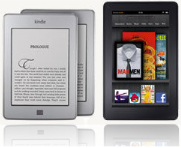


Touch screens are very sensitive and it's a good idea to cover them with a clear screen protector. I've been using a ZAGG Invisible Shield on my iPad for a couple of years now but I've never liked the bumpy feel it has. I've wanted to put something on my Kindle Touch but I wanted to avoid that "orange skin" texture you get with Invisible Shield.
And then I discovered XO Skins.
XO Skins are everything Invisible Shields are, but without the bumpy texture. That means they go on easy, are extremely durable and never bubble up. The one I put on my Touch actually seems to improve the readability of the screen. It's such a clear, smooth surface and it never smudges. XO Skins are very easy to install and the results are outstanding. I highly recommend them for all your devices.
Monday, January 30, 2012
XO Skins: My New Favorite Screen Protectors

Monday, December 12, 2011
Why I Rooted My Kindle Fire
Actually, a more accurate title would be, "Why I Had My Son Root My Kindle Fire." He had some spare time this weekend so I asked him to do the job for me. I simply emailed him this link, handed him my Fire and told him not to worry about the results. After all, I've hardly used my Fire since it arrived. I do all my book reading on my new Kindle Touch (highly recommended) and intended for the Fire to replace my iPad. But it hasn't.
My favorite iPad apps are Zite and Flipboard. Neither of them are available on Android. More importantly, I kept running into interesting apps that are available in the Android Market but not Amazon's appstore.
The rooted device looks and acts a lot like it did before. One key difference is that I can now go to the Android Market and download whatever I want. Here are a few I installed immediately:
The real Twitter app -- It's totally ridiculous that Amazon doesn't offer this one. Prior to this my Fire twittering took place in the browser. Awful idea.
The Dolphin browser -- Don't get me started about the Fire's supposedly super-fast Silk browser. I've done side-by-side test with my iPad, Galaxy S II phone and Mac PowerBook Pro. The results show the Fire browser comes in last place pretty much every time I load a page, reload a page, etc. This is one of the most disappointing aspects of the Fire. I originally planned for it to be a fast, small browsing device. Now that I have Dolphin installed it's at least as fast as my iPad. Amazon should publicly apologize for the misleading promises they made about Silk.
The Everpaper app -- I'm a big fan of Instapaper. The Fire's smaller size should make it a better alternative for this sort of short-form reading than the iPad. Sure Amazon offers InstaFetch but it's not as good as Everpaper. I'd argue that Everpaper is a better app than Instapaper's own one on iOS. Isn't Amazon supposed to curating a list of the best apps for their own app store? If so, why are they leaving this terrific one out?
News360 -- This one is an excellent news aggregator that's well designed for a tablet user interface. Again, for some silly reason Amazon has decided it's not worthy of their own app store.I could go on and on but I won't. I'm sure I'll discover more each day and I'll be sure to report the best ones on Kindleville. I should also mention that every Android Market app doesn't come with a simple installation process on a rooted Kindle. In fact, I've come across a number of apps that simply don't show up in the Market search results when I look for them on my Fire. The solution there is to back up the .apk file on my Android phone and email them to myself. I then open the .apk on my Fire and most install just fine. Btw, if you need to do the same you'll want to install the free ASTRO File Manager app on your phone. It's a great little tool.
Then there are the apps that, for one reason or another, simply won't install on a rooted Kindle Fire. The biggest disappointment so far is Google Currents. I'm getting tired waiting for Zite and/or FlipBoard to appear on the Android platform and Currents is a nice app on my iPad. I've tried installing it a couple of times on my rooted Kindle and it always ends with a failure message. Bummer.
I'm also pretty sure the next time Amazon pushes out a Fire OS update it will unroot the device. My son tells me he can re-root it in a matter of minutes though now that he's done it once. That's good news because there's no way I'm going back to the walled ghetto Amazon has created with the standard Fire setup.
Monday, November 28, 2011
The Kindle Fire Needs a Killer App
My Kindle Fire is proving to be a decent ebook reader and a worthy tablet. I can't ditch my iPad though because I can't abandon Zite or Flipboard. I consider both of them to be killer apps for the iPad platform. Neither of them were available when the iPad was launched but I'm so hooked on them now that I can't imagine losing either one of them.
Given how long the Kindle Fire was in development I have to admit I'm disappointed that Amazon didn't see to it that one (or both) of these apps were ported to the Android platform at launch. I can understand why the developers behind Zite and Flipboard hadn't ported their apps to Android yet. Prior to the Fire no Android tablet made a dent in Apple's market dominance. But everyone realized the Fire was going to change that situation, so it wouldn't have been all that risky for either company to port to Android earlier this year. They didn't though, so the door is wide open for someone to create a Zite-like or Flipboard-like app for the Fire.
Meanwhile, there are no apps out there that truly make the Fire unique. A cheap tablet is great but Amazon needs to make sure one or more irresistible apps get developed soon for their shiny new device. And please don't tell me Amazon's content and cloud strategy are the Fire's killer app. I'm not buying it. It makes for a nice platform but delivery pipelines aren't what make people buy (and remain loyal to a tablet). Unique apps do though, as evidenced by my need to keep lugging my iPad everywhere I go.
Tuesday, November 22, 2011
Shhh...Don't Tell Amazon You're Loading These Apps on Your Kindle Fire
Up to now I've only bought ebooks from Amazon because I figure they offer a great multi-platform service. I can read those books on my Kindle hardware, my Mac, my iPad, a Windows PC, etc. Good luck doing that with books you buy from the iBookstore.
We all know the Kindle Fire is based on the Android operating system and you probably realize that only a small number of Android apps are offered through Amazon's Appstore for Android. That's because Amazon wants to limit the apps you run on your Fire. In some cases they're trying to prevent you from a buggy or unpleasant experience. In other cases though, they're just looking out for their own revenue stream.
So what if you've bought some ebooks from Barnes & Noble? Are you out of luck and unable to read them on your Fire? No way. Thanks to the extremely easy steps outlined in this article you too can load not only the nook app on your Fire but also a bunch of other non-Amazon-sanctioned Android apps as well. Btw, there's no rooting involved in this solution. It took me less than 5 minutes to implement and now I have access to a much larger list of apps for my Fire. Highly recommended!
Monday, November 21, 2011
Kindle Fire & Touch: First Impressions
I thought everyone was pre-ordering both a Kindle Fire and a Kindle Touch so I did too. Now a lot of people are asking me why I got both. More on that in a bit. After using the Fire and the Touch for a few days now I wanted to share my initial thoughts on each of them.
Kindle Fire
When I heard the Fire was going to be roughly the same size as the RIM Playbook I was pretty excited. I've got a Playbook and, although it has almost no apps to speak of, RIM's form factor is perfect for me. I bought a first-gen iPad on day one and I've enjoyed using it but I've always felt it's too bulky, especially when you have to lug around a laptop in addition to a tablet. It's been said that tablets are much better at content consumption than content creation, so why have something as large as an iPad when consumption can be accomplished on an even smaller screen? I'm finding the smaller Fire is a much better match for my needs.
The major disappointment with the Fire so far, as reported elsewhere, is the unimpressive results from the Silk browser. Amazon really played this up and many of us were expecting a speedy browsing experience. In reality, the Fire's browser is no faster than my iPad's. It makes you wonder how Amazon benchmarked this and why they feel it's superior.
I've been outspoken about the need for a better way to manage and organize content on a Kindle and I'm not convinced Amazon's Carousel view is the solution. It has all the sizzle of Apple's cover flow without an underlying folder structure. Have you grown accustomed to the Collections organization capability of your eInk Kindle? Get used to living without it on a Fire. That's right. One step forward, two steps backwards. One minor advantage to the Fire user interface is the Favorites section. That's the smaller-sized view of covers at the bottom of the screen. If you're reading 3 books at the same time, just drag them down there so they don't get lost in the larger Carousel clutter. And speaking of clutter, is there really a reason for so many operations to add items to the Carousel? Open a new tab in the browser, go back to the home screen and there's an image of that web page added to the Carousel. Yuck. Amazon needs to get a UI expert to help them reconfigure the main screen and navigation.
Finally, my last beef with the Fire has to do with the app selection. There are a number of iPad apps I use that aren't available on Android. Zite is the most important one. I can't imagine a day without Zite. It's an amazingly useful app but it's for iOS only. I realize there haven't been any successful Android tablets up to now and that's why developers like Zite haven't bothered with an Android version. But surely they saw the enormous potential for the Fire, so why weren't some of these killer apps available on day one? I'm forced to use both an iPad and my Fire till more of these apps are ported. If you buy a Fire, btw, don't limit yourself to only those apps Amazon offers. Here's a link to a very simple series of steps you can take to open your Fire up to a large number of additional ones, including, believe it or not, the B&N nook app!
You might think that with all these complaints I regret buying a Fire. You'd be wrong. I'm optimistic Amazon will address all of these issues in the coming months and I have no buyer's remorse whatsoever.
Kindle Touch
My third-gen Kindle is less than a year old but knew I wanted to upgrade to the Touch as soon as I heard about it. I never liked it that so much Kindle surface area was dedicated to a lousy keyboard that gets used, at best, perhaps 1% of the time I'm holding the device. It made no sense.
The Kindle Touch is a terrific device. I opted for the $99 Touch with Special Offers. The "offers" are totally unobtrusive and never appear during the reading experience. I have yet to find one I want to take advantage of but if this program helps lower the cost of the device I'm all for it.
The touch screen is great but not exactly perfect. It's clear that eInk displays aren't intended for use with something like a virtual keyboard where you want instant feedback that the right key was pressed. The delays are a bit irritating. Then again, since the keyboard is used so infrequently it's not a big hassle. It's so nice though that I can now simply touch or swipe the screen rather than hunt for the physical button for any operation.
I've noticed a bit more screen ghosting with the Touch than I had with my third-gen Kindle. I believe the new eInk display technology is to blame for this. Amazon offers a new option called "Page Refresh" on the Touch and it's set to "off" by default. If you've used a Kindle before you're familiar with the screen flash that happens each time you turn the virtual page of an ebook. What's happening is every little dot on the screen gets reversed before the next page is displayed. With this new setting in the off mode you don't see so many of those flashes but you wind up with a bit of ghosting. It's easy enough to flip the switch to "on" and the ghosting goes away.
The Touch is even smaller than the already lightweight third-gen Kindle and the battery seems to last even longer, if that's possible. You could easily tuck the Touch in your backpocket (assuming you're not concerned about sitting on it, which you should be!).
The bottom line is I'm very happy with both these devices. So why did I buy more than one? I'm hooked on eInk for long-form reading. As crisp as the Fire's display is, I find eInk to be a much more comfortable reading experience. I wouldn't want to do much web browsing on a Touch though and, of course, the Fire is much more extensible via the app ecosystem. I've been using both a tablet (iPad) and an eInk device (Kindle) for most of 2011 and I don't see that changing. It would be great if eInk would offer full color since that would allow me to go with one device instead of two. That doesn't appear to be on the short term horizon so, for now, I'll continue using two devices.
Wednesday, November 16, 2011
How Frequently Will Amazon Release Kindle Fire Software Updates?
It's unfortunate (for me) that Amazon decided to deliver my new Kindle Fire while I'm out of town. New Fire and Touch devices are waiting for me at home though and I can't wait to try them out. In the mean time I've been living vicariously through all the bloggers and tweeters who have written about their initial Fire experiences.
Monday, November 7, 2011
We Need A Better Way to Manage Content
When the Kindle first arrived there was no way to create groups. Every book, newspaper or magazine just got plopped onto the home screen. As a result, everyone's home screen quickly turned into many home screens and you had to flip through page after page to find what you're looking for.
Fast forward to today where we now have the ability to create Collections. Terrific. It's 2011 and the state-of-the-art Kindle content organization technique is something MS-DOS supported way back in the 1980's. Can't we do better than this?
Here's my problem. I'm constantly downloading samples and buying new ebooks. I also have subscriptions to a couple of magazines on my Kindle. There's so much stuff piling up that I can't remember what I wanted to read next. In short, there's no way to prioritize my Kindle reading list!
In the old days I'd just stack my books on my desk or nightstand and I'd make sure the important ones were on top. That works when you're only reading 3 or 4 books at a time, but what happens when you're juggling a half dozen or more as well as thinking about reading any one of 10+ samples? The current model breaks down.
Here's one simple solution: How about automatically pouring all of my samples into a Samples Collection? That would be pretty easy and I'll be Amazon could code that up in no time. Or how about this?: Let me assign a priority to each of the books, magazines, samples, etc., that I download. Then let me sort my library by priority. Even better!
I'm sure a great user interface designer could come up with a variety of solutions to this problem. I hope they do it soon because I keep losing track of what I want to read next!


